
PortfolioPilot 3.0 Introduces Financial AGI, Outperforming Human Benchmarks
After years of hard work and product evolution, PortfolioPilot is proud to announce that it is introducing “Financial AGI” to the world.
We realize that AGI (Artificial General Intelligence) is a poorly defined term, and financial AGI is even more so. So, to avoid any confusion, we choose to define financial AGI in a narrow fashion:
A platform that has achieved financial AGI is one that can accurately perform the majority of day-to-day analytical and advisory tasks performed by competent finance professionals.
The bar must be high for any platform to meet this term.
Based on the above definition, we have selected 7 criteria that we feel would give any platform the right to claim having achieved financial AGI:
- Breadth and depth
- Context processing and personalization
- Learning
- Explainability
- Compliance and auditability
- Price
- Speed
Landing on these criteria entailed plenty of research, long debates, and consultations with experts.
Throughout this article, each criterion is defined in detail, and we demonstrate how each criterion is met.
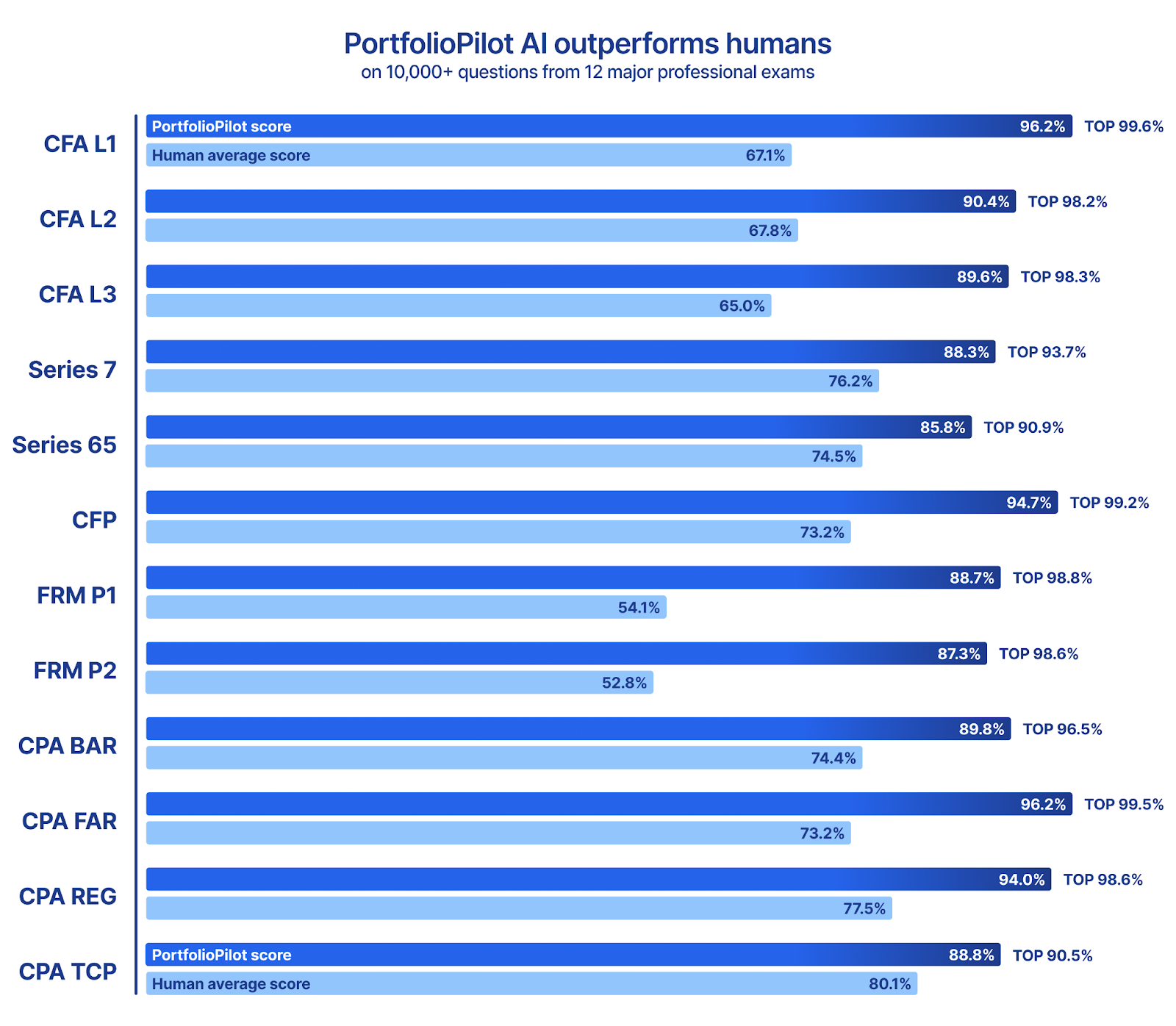
For instance, to demonstrate breadth and depth in our internal study, we had our platform tackle 1000’s of exam-style questions inspired by 12 standardized professional exams taken by financial advisors. We then compared how we fared in aggregate with how test takers perform on average on the aforementioned exams.
Here are the results:
These results were possible thanks to the technical sophistication of our platform. (We explore that further down below)
The full report, justifications, assumptions, and exam criteria are expanded in our internal 41-page document titled “Financial AGI Substantiation Paper”. This will be referred to as the “Internal report”.
The definition of financial AGI
Because "AGI" (Artificial General Intelligence) has no universally accepted definition, the term "Financial AGI" is defined here as a domain-specific standard that is measurable, auditable, and intentionally narrow. Accordingly, for a platform to meet this definition, it must be so much more than a "financial chatbot", online investor tool, or Robo-Advisor.
What does it mean for a platform to achieve financial AGI?
A platform that has achieved financial AGI can perform the majority of day-to-day analytical and advisory tasks performed by competent finance professionals (e.g., financial research analysts, investment adviser representatives, wealth managers) across a broad set of personal finance and investment domains, at or above a professionally competent threshold, while providing:
- Transparent, user-facing explanations and assumptions
- Verifiable grounding in current financial data
- Personalization to an individual user’s full financial context
- Controls sufficient for operation within an SEC-registered investment adviser’s compliance and cybersecurity program.
To make said competent threshold more concrete, a platform must perform as well as, if not better than, the top 25% of all human financial advisors.
It is also just as important to delineate what financial AGI is not:
- It is not broad AGI: the system is not designed to perform arbitrary human tasks outside finance.
- It is not superintelligence: the claim is benchmarked to competent professional performance, not perfection.
The criteria for Financial AGI and how PortfolioPilot meets them
Let’s dive deeper into each criterion necessary for financial AGI. We will look at:
- What it is and what is needed to show its existence
- How PortfolioPilot meets it
1. Breadth and depth
Breadth is defined as the platform’s ability to cover a wide scope of financial topics that cut across the entire spectrum of financial advisory services. Depth is defined as the quality of the answers and services provided by the system to any given financial topic.
To meet the breadth component, we believe that a platform asserting that it has achieved financial AGI should be able to solve and pass different standardized exams that pass the 50 topics across the financial domain (e.g. portfolio risk analysis, external audits, tax calculations for retirement planning, etc). These topics are covered by 10,000+ exam-like questions across the following 12 professional exams: CFA (All three levels), Series 7, Series 65, CFP, CPA FAR, CPA Reg, CPA BAR, CPA TCP, FRM P1, FRM P2.
To meet the depth criterion, a platform must be capable of achieving a score that places it at least in the top 25% of all human test takers.
How PortfolioPilot meets this criterion
Regarding breadth and depth, the table below highlights how PortfolioPilot performed across the exam-style questions related to the various tests and how its representative scores compare to those of the average human test taker.
(The internal study shows detailed calculations and methods for arriving at the above numbers)
Seeing as the platform comfortably outperforms 90% of human test takers across all of the above tests, it passes this criterion.
2. Context processing and personalization

For a platform to achieve financial AGI, it must ensure its advice and recommendations account for users’ unique contexts and preferences.
As a result, a platform needs to be able to show how it factors a user’s unique context and preferences into the recommendations it offers.
How PortfolioPilot meets this criterion
All modules in the Portfolio Management System are dedicated to providing users with personalized advice tailored to their portfolios.
For instance, the top recommendations offered to the user are based on a host of elements, including:
- Which suggestions provide the largest improvements to the user’s portfolio score
- Which securities are held by similar investors and would make sense to be recommended here
- Which securities match the investor’s stated preferences
Of the several variables used to direct the platform’s responses and recommendations, here are some that the user explicitly specifies:
- What they want the platform to help with (e.g. increasing risk-adjusted returns vs. boosting downside protection)
- Which sector they work in
- Their tax filing status
- Their stated risk preference
- Their primary investment objective and main financial goals
- The kind of securities for which they would like to see recommendations
- The kind of asset classes for which they would like to see recommendations
- Any restrictions the user might have with regard to fund fees or fund dividends
- The level of fund eccentricity preferred by the user
On top of all of this, the platform leverages its understanding of the user’s full net worth, of the different asset classes held by them, and of the chat history between the user and the AI assistant.
All of these variables factor into the recommendations offered.
3. Learning
A platform must also adjust its recommendations based on user feedback and improve the quality of its advice over time.
Accordingly, to meet this criterion, the platform needs to show:
- How it collects feedback from its users
- How this feedback influences future recommendations
- How collective feedback impacts the platform as a whole (e.g. if a large swath of users provides the same feedback, how is that factored into the platform?)
How PortfolioPilot meets this criterion
PortfolioPilot improves using feedback, but only under controlled governance. We believe that feedback loops must be privacy-preserving and supervised.
A case in point regarding how feedback updates our system is the Portfolio Management System. It leverages both global and personal preferences to tweak its recommendations:
- Global preferences: The engine will select potential securities based on what other people are holding as well as based on the other recommendations that different users have widely accepted or rejected. For instance, if the Engine finds that a certain recommendation has been rejected widely by PortfolioPilot’s user base, then it will adjust accordingly and suggest it less in the future.
- Personal preferences: The engine adjusts its recommendations based on the user’s preferences, both stated and unstated.
- Throughout their everyday use of our platform, users indirectly express certain preferences. For instance, if they reject, downvote, or just refuse to act on a certain recommendation, then this gets factored into the recommendation engine and alters future recommendations.
- The recommendation engine also factors in the user’s similarity to other users of the platform, and accordingly, it will offer suggestions based on the recommendations that have proven popular with other similar users.
4. Explainability
Whenever a platform offers a solution, insight, or advice, it must be able to also provide a clear explanation on why this makes sense and is suited to the user.
Here, the threshold for meeting the criteria needs to be twofold:
- The platform must be able to explain the logic behind every recommendation or suggestion
- The ramifications of every financial suggestion, both good and bad, must be highlighted so that the user makes the best-informed decision possible.
How PortfolioPilot meets this criterion
Here is how PortfolioPilot meets both of the aforementioned criteria:
- When the platform offers a recommendation, it also explains why the recommendation makes sense for the user and their portfolio.

- When having a conversation with the AI assistant, it will highlight the different pros and cons of a decision.

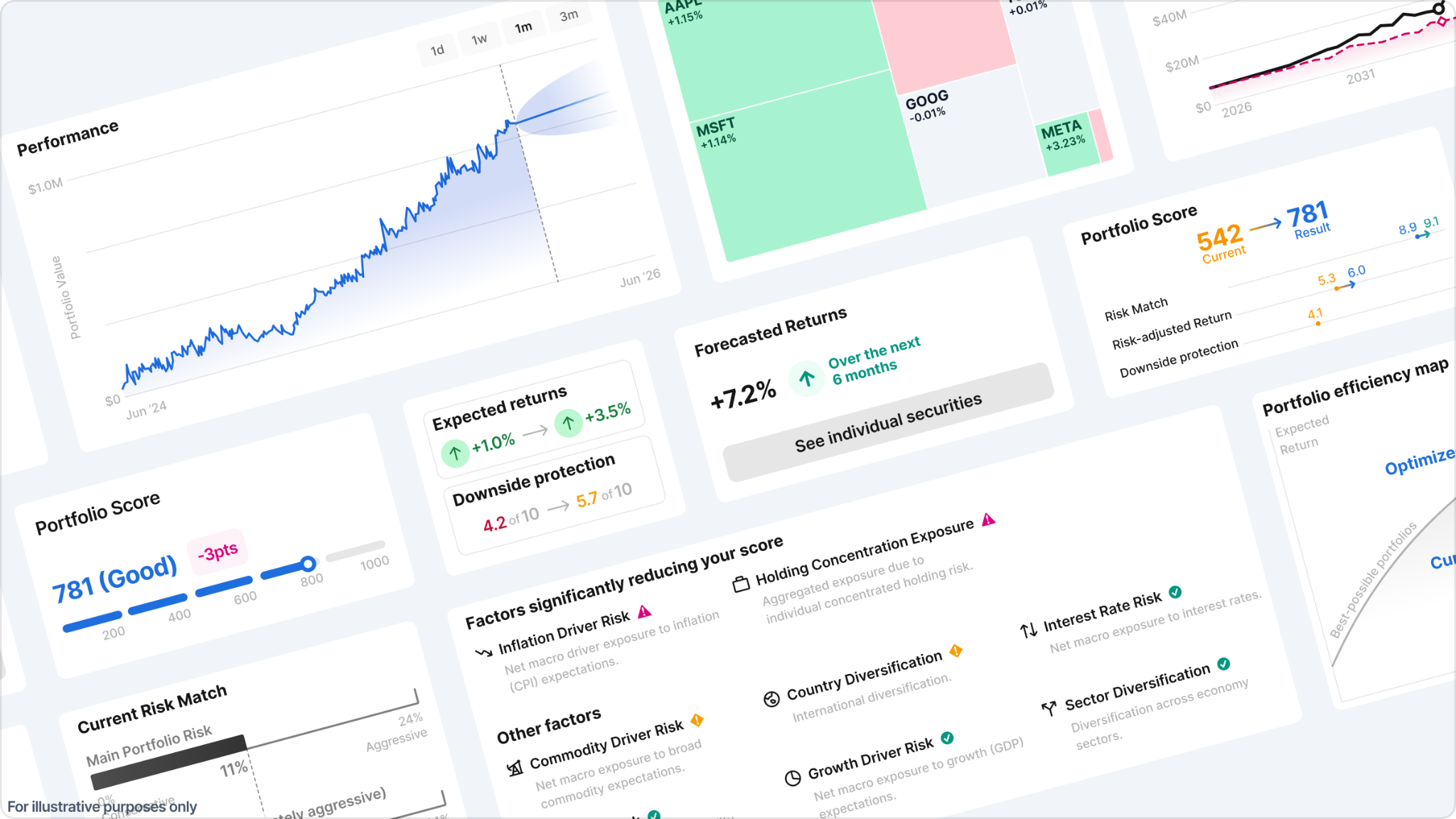
PortfolioPilot can also show tax calculations, detailed year-by-year analysis in its retirement planning, look-through analysis, Portfolio Score breakdowns as part of its portfolio analysis, comparison tools, and individual analysis & forecasts across 60,000+ securities.
5. Compliance and auditability
A platform claiming financial AGI must operate controls consistent with those of an SEC-Registered Investment Adviser.
Additionally, to meet this criterion, there are 4 elements that are worth mentioning:
- Account connectivity and credential handling
- Encryption and data protection
- Audit logs and recordkeeping
- Marketing claim controls
How PortfolioPilot meets this criterion
To demonstrate that PortfolioPilot meets this criterion, we will go through the aforementioned elements:
Account connectivity and credential handling
Connected accounts are accessed via secure, read-only connections through trusted partners. PortfolioPilot does not store user banking credentials; the user maintains control of access. User data is processed in an anonymized and encrypted form within secure databases.
Encryption and data protection
Encryption and data protection are met through the following elements:
- 256-bit encryption at rest and in transit for sensitive user data.
- Access controls following least-privilege, with environment separation (dev/test/prod).
- Vendor risk management for account aggregation and market data providers.
Audit logs and record keeping
Audit readiness requires retaining, subject to applicable privacy policies and recordkeeping rules: user context (holdings/goals assumptions), tool/model outputs used in recommendations, model/data version identifiers, and the final delivered output with disclosures. Logs support reproduction, supervision, and incident investigation.
Marketing and claim controls
Public statements about AI capabilities (including "Financial AGI") must be reviewed and substantiated with objective substantiation. Claims should be limited to what the system does in production for real users and must avoid implying guaranteed outcomes.
6. Price
A platform must be accessible at a cost-efficient rate, especially when compared to human financial advisors. A platform that is prohibitively expensive would not be available as a general purpose tool, as is implied in the AGI framing.
To be consistent with previous definitions, the platform must be less expensive than 75% of all human financial advisors (i.e. at or below the 25th percentile of financial advisory costs).
How PortfolioPilot meets this criterion
From research available in the internal paper, the typical range for flat annual fee financial advisors ranges from $2,500 to $9,200 (with an average of $5,850 and 25th percentile at $4,744).
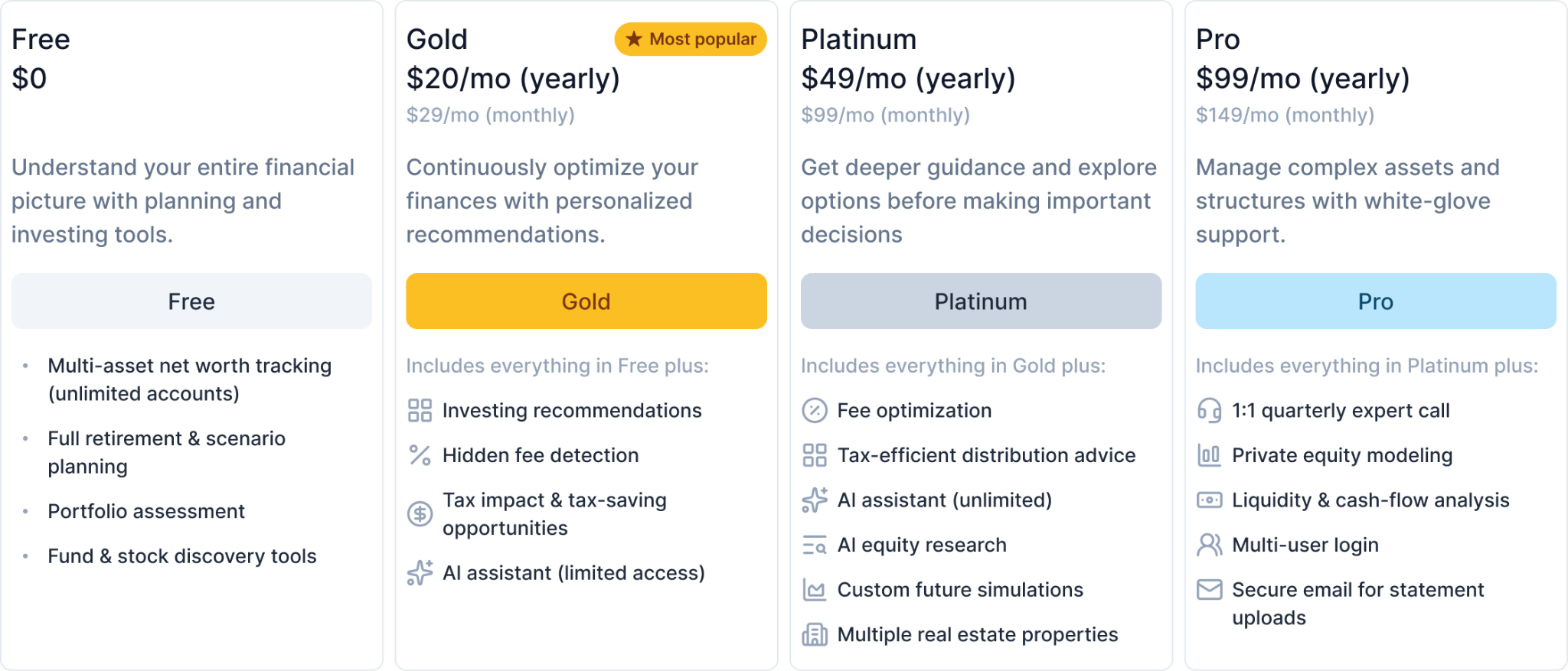
As of this writing, PortfolioPilot has 3 paid tiers:
- The Gold tier costs $240 per year
- The Platinum costs $588 per year
- The Pro plan costs $1,188 per year
All of these plans cost less than $4,744, meeting the cost criterion.
7. Speed
A platform claiming financial AGI must rival, if not exceed, human financial advisors in the speed of response and service delivery.
Consequently, using the benchmark tests mentioned in the breadth and depth criterion, we must show that our platform was able to solve the exam-style questions quickly enough to meet the official exams’ time constraints.
How PortfolioPilot meets this criterion
With regards to speed, the metric here is the number of questions the platform solved per minute compared to the required rate of questions per minute necessary to finish the entire exam in the allotted time. (a conservative threshold)
Taken from our internal study, the table below summarizes these results:
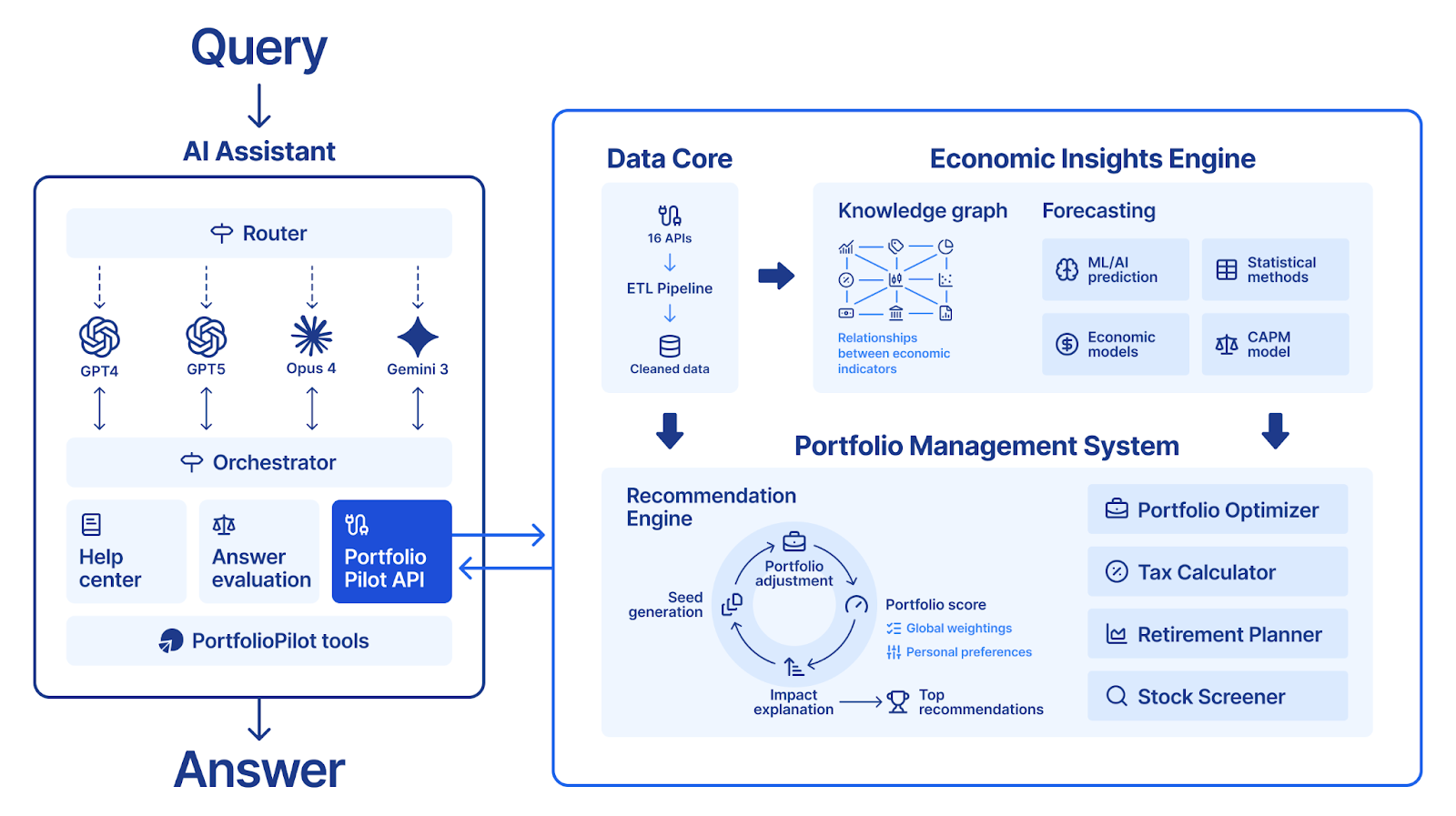
The breakdown of PortfolioPilot’s technical system:
PortfolioPilot is built on a stack of models and data that combine economics, finance, and ML/AI.
The system can be broken down into 4 main components:
- Data Core
- The Economic Insight Engine
- The Portfolio Management System
- The AI assistant
The Data core enables the platform to connect financial data, news, macro insights, user data, and historical trends through a global economic map. To that end, the platform aggregates macroeconomic, financial, and market data through 16+ APIs and proprietary scrapers. [More info]
The Economic Insights Engine connects recommendations with macro context: trends, relationships between indicators, and continuous monitoring of changing scenarios.
It provides portfolio-specific interpretation influenced by economic models. [More info]
The Portfolio Management System incorporates quantitative portfolio construction frameworks inspired by institutional asset management. [More info]
Broadly speaking, the portfolio management system can be broken down into the following 5 modules:
- Recommendation Engine
- Portfolio Optimizer
- Tax Calculator
- Retirement planner
- Stock Screener
Finally, the AI Assistant is not a standalone chatbot. It sits on top of all of the aforementioned modules - from data infrastructure and forecasting to portfolio optimization and recommendations. The AI Assistant can access portfolio insights, answer specific security questions as part of the user’s research, answer investing questions, and teach the user more about the platform. [More info]
Conclusion
Having set a clear, narrow definition for financial AGI, we outlined the 7 main criteria that we saw were critical for meeting said definition.
Subsequently, we demonstrated how Portfolio AI met and even surpassed the necessary benchmarks in several cases. For instance, when demonstrating breadth and depth, the platform proved to relatively perform better than 90% of all individuals vying to become financial advisors.
Meeting the different criteria was made possible thanks in large part due to the system’s sophisticated architecture and its advanced models.
And, if you would like to test or explore the platform yourself, we invite you to do so.
Disclosure:
This material is for informational and illustrative purposes only and is not a solicitation, offer, or recommendation to buy or sell any security. Global Predictions provides personalized investment advice only to individuals who formally enroll and enter into a written advisory client agreement.
Investing involves risk, including the possible loss of principal, and investment values may fluctuate. You should consider your individual objectives, financial circumstances, and risk tolerance before investing and consult your legal, tax, or investment professional as appropriate. Registration does not imply a certain level of skill or training.
“Financial AGI” is a descriptive term only and does not imply human-level intelligence, professional licensure, certification, or equivalence. Any internal benchmarking against financial industry examination materials measures conceptual knowledge only and does not represent investment performance or professional judgment.
System outputs are based solely on user-provided information and embedded methodologies, data inputs, and assumptions. The system does not independently verify inputs and does not provide tax or legal advice.
