
Common Mistake #4: Not Automating Savings and Investing

Consistent investing matters more than most people expect. According to Vanguard, the way a portfolio is allocated across asset classes has historically been the most significant determinant of long-term investment outcomes - outweighing the impact of individual security selection. Research and investor education from Vanguard emphasize that strategic asset allocation drives the bulk of long-term return variability in diversified portfolios.
This article explains why failing to automate savings and investing is a common but underestimated mistake, how it quietly compounds behavioral risk, and why good intentions alone rarely survive real life.
Key takeaways
- Irregular contributions introduce timing and behavioral risk.
- Automation reduces reliance on motivation, memory, and mood.
- Missed contributions often matter more than poor investment selection.
- Market volatility amplifies the cost of inconsistency.
- Systems outperform willpower over long horizons.
Why manual investing feels flexible - and responsible
Many investors prefer control. Deciding when and how much to invest feels thoughtful, adaptable, even disciplined. Waiting for the "right moment" or contributing when cash flow feels comfortable appears sensible.
This flexibility is reinforced by short-term realities. Expenses fluctuate. Life gets busy. Markets feel uncertain. Deferring a contribution doesn't feel like a mistake - it feels practical.
Up to this point, nothing looks irresponsible.
That's exactly why the problem persists.
Here's the hidden cost most investors don't track
The real issue with manual investing isn't that people never invest. It's that contributions become irregular, delayed, or skipped entirely - often without being noticed.
Missed contributions rarely trigger alarms. There's no statement labeled "lost compounding." No notification that says "this month mattered more than you think."
But over time, inconsistency compounds quietly.
So what? A portfolio can underperform not because markets were unkind, but because capital wasn't deployed when it could have been.
This is Where inconsistency turns into structural drag
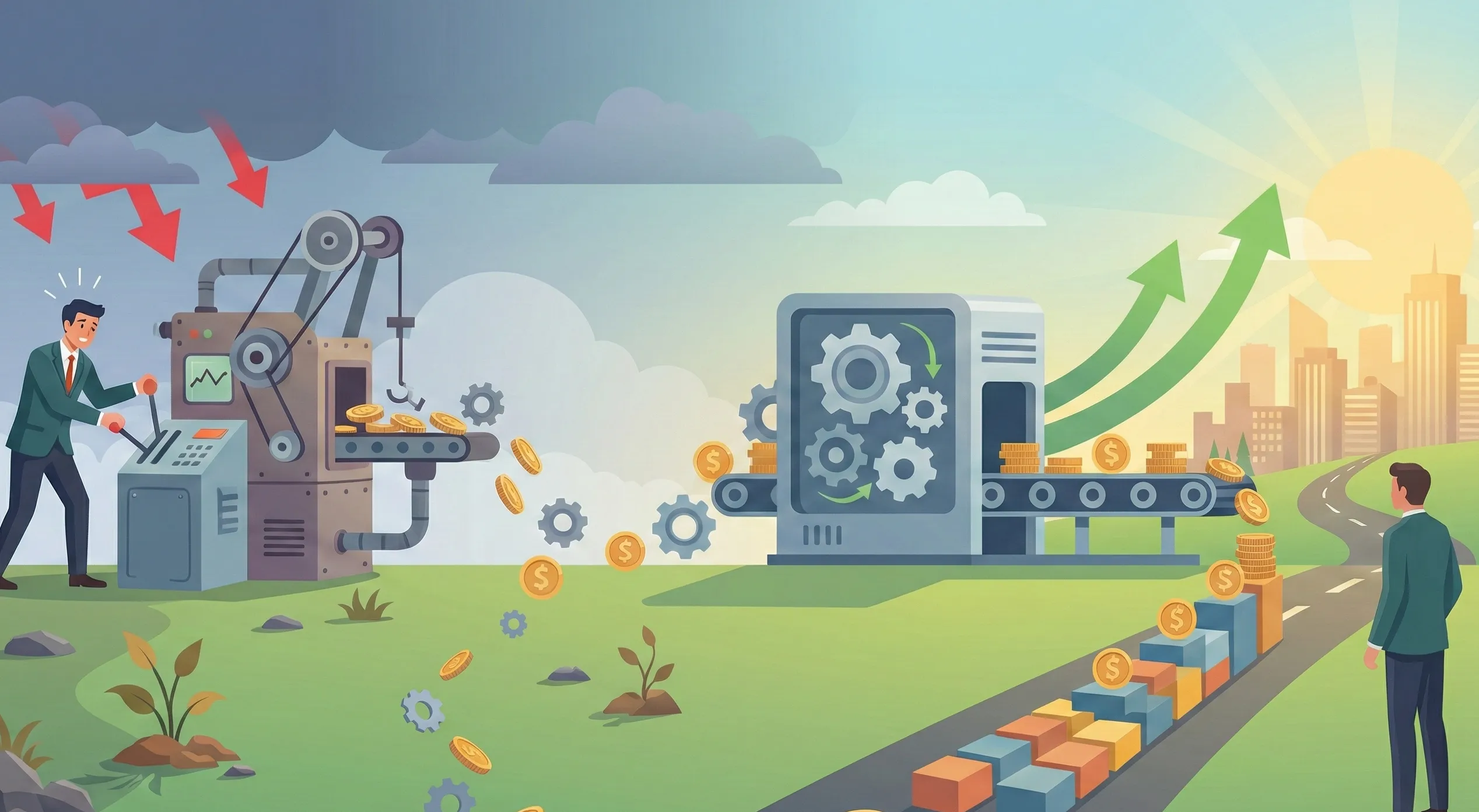
Hypothetical example: Imagine two investors with identical income, risk tolerance, and asset allocation. One invests monthly through automatic contributions. The other invests manually, contributing when markets feel calm or when cash feels abundant.
Over a decade, both have invested similar total amounts. Yet the automated investor captures more market exposure during volatile periods - when prices are lower and future returns tend to be higher. The manual investor, by contrast, tends to pause contributions during uncertainty and resume after confidence returns.
The difference isn't intelligence. It's exposure.
Automation doesn't predict markets. It removes hesitation.
Why volatility makes automation matter more
Market downturns don't just test portfolios. They test habits.
During stress, investors are more likely to delay contributions, hold excess cash, or wait for "clarity". Behavioral finance research shows that uncertainty increases loss aversion, making inaction feel safer than commitment. This creates a subtle asymmetry:
- Contributions slow when expected returns are higher
- Contributions accelerate when prices feel safer - but less attractive
Without automation, many investors unintentionally buy less when markets are discounted and more when optimism returns.
This is how inconsistency becomes a long-term drag.
Why good intentions rarely survive real life
Most investors don't plan to be inconsistent. They plan to "stay on top of it". But manual systems rely on:
- Memory
- Emotional bandwidth
- Ongoing motivation
- Perfect timing
Life intervenes. Work gets busy. Expenses arise. Markets fluctuate. Decisions get postponed.
Automation works precisely because it removes the need to decide repeatedly. It converts a goal into a process.
This isn't about discipline. It's about design.
The one constraint that keeps progress moving
Investors who avoid this mistake often adopt a simple rule:
Saving and investing happen automatically unless there's a specific reason to stop.
This reframes contributions from a choice into a default.
Automation doesn't guarantee outcomes. It guarantees participation. Over long horizons, participation matters more than precision.
Supporting choices - such as aligning contribution schedules with pay cycles or separating short-term cash from long-term investments - exist to protect this rule, not complicate it.
When not automating can make sense
Automation is not universal. Some investors with irregular income, variable expenses, or near-term liquidity needs may rely more on manual contributions.
The difference, again, is intent.
Manual investing works when it is deliberate, structured, and reviewed regularly. It becomes a mistake when contributions depend on memory, mood, or market headlines.
Automation succeeds not because it's optimal - but because it's consistent.
How optimized is your portfolio?
PortfolioPilot is used by over 50,000 individuals in the US & Canada to analyze their portfolios of over $40 billion1. Discover your portfolio score now: