
Common Mistake #31: Leaving an Old 401(k) Behind After a Job Change

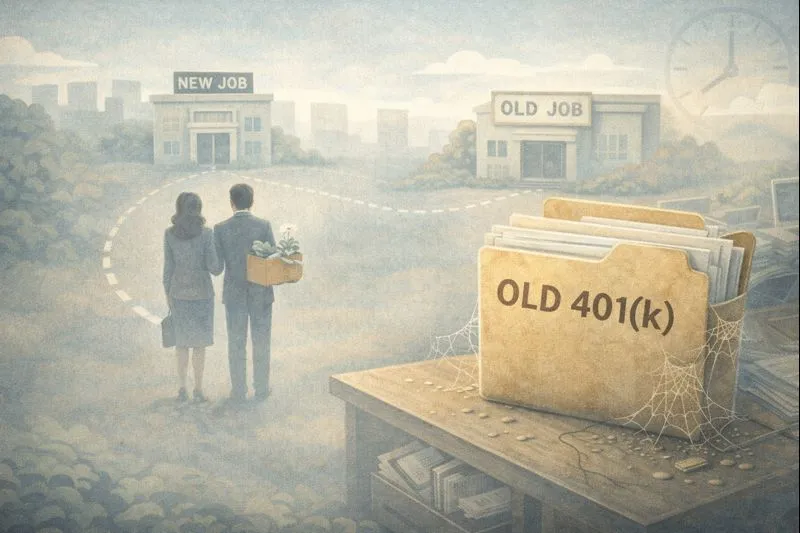
Job changes are disruptive by nature. New responsibilities, new benefits, new routines. Amid that transition, one asset often fades into the background: the old 401(k). Industry estimates suggest that trillions of dollars remain in former employer retirement plans, many of them untouched for years after workers move on.
Leaving an old 401(k) in place may feel harmless - or even prudent. This article explains why failing to reassess and potentially roll over an old 401(k) is a common but overlooked mistake, how it can quietly limit flexibility and efficiency, and why inertia, not intent, is usually the deciding factor.
Key takeaways
- Old 401(k)s often come with limited investment menus and plan constraints.
- Inactive accounts are easy to forget and rarely revisited.
- Fees and inefficiencies compound quietly over time.
- Fragmented retirement accounts reduce visibility and control.
- Job changes are inflection points that often go unused.
Why leaving an old 401(k) feels like the safe choice
After changing jobs, most people default to stability. The old account is still invested. Statements still arrive. Nothing appears broken.
There's also perceived risk in moving money. Paperwork feels complex. Mistakes feel costly. Doing nothing feels neutral.
Up to this point, the decision not to act feels responsible.
That's exactly why this mistake persists.
Here's the constraint most investors don't revisit
Once employment ends, a 401(k) doesn't disappear-but its structure freezes.
Investment options are locked to the former employer's plan. Fee structures may no longer be competitive. Features that once made sense for a broad workforce may not align with an individual's evolving goals.
So what? The account keeps growing, but under rules that no longer adapt.
This is where neutrality quietly becomes a trade-off.
This is where inertia turns into structural drag
Hypothetical example: Imagine an investor who changes jobs several times over a career. Each time, the old 401(k) is left behind. Over decades, retirement savings become scattered across multiple plans - each with different investment menus, fee structures, and administrative rules.
No single account is problematic. Collectively, oversight erodes.
Asset allocation drifts. Rebalancing becomes harder. Some accounts remain invested according to assumptions made years earlier. Fees vary, but the total cost is never reviewed in one place.
Nothing breaks. Efficiency just slowly leaks away.
Old 401(k) After Job Change (Hypothetical)
Why rolling over often comes up late, if at all
Rollover decisions aren't time-bound. There's no deadline forcing action after a job change. New employers rarely prompt a review of old plans.
Behavioral research shows that when decisions lack urgency, they are postponed indefinitely - even by financially engaged individuals.
Markets' rising can mask inefficiency. Balances increasing reduce perceived need to act.
The issue isn't a lack of knowledge. It's a lack of a trigger. Part of that inertia is structural. Employer plans are not designed to prioritize portability, and rollover processes often involve multiple parties, paperwork, and coordination across institutions. While the steps are generally well defined, the perceived complexity alone is enough to delay action indefinitely for many investors.
Why flexibility matters more than it appears
Employer-sponsored plans are designed for scale, not customization. Investment menus are limited by necessity. Fees reflect plan-level economics, not individual choice.
Over long horizons, these constraints can matter.
Accounts that are easier to monitor, rebalance, and evaluate together tend to reflect the current strategy. Accounts left behind tend to reflect past employment and past assumptions.
This is where account location quietly influences outcomes.
The reframe that breaks the pattern
Investors who avoid this mistake often adopt a simple reframe:
A job change is a structural checkpoint, not just a career one.
This reframing doesn't mandate a specific action. It prompts evaluation.
Supporting considerations-such as comparing fees, investment flexibility, and administrative simplicity across account types-exist to inform decisions, not force them.
The goal isn't movement for its own sake. It's alignment.
When leaving an old 401(k) can still be intentional
There are cases where keeping assets in a former employer's plan makes sense, such as access to specific investment options or plan features that align with an investor's needs.
The distinction, consistent with the rest of this series, is awareness.
Leaving a 401(k) behind becomes a mistake when it's driven by neglect rather than choice.
Retirement structure should reflect current priorities - not past employers.
How optimized is your portfolio?
PortfolioPilot is used by over 40,000 individuals in the US & Canada to analyze their portfolios of over $30 billion1. Discover your portfolio score now:

An easy way to plan your financial future
PortfolioPilot helps you plan and achieve your retirement goals, with financial models that predict your retirement success and calculate the taxes involved.

.webp)