
FX Impact Estimator (multi-currency) - Tool

How the Tool Works
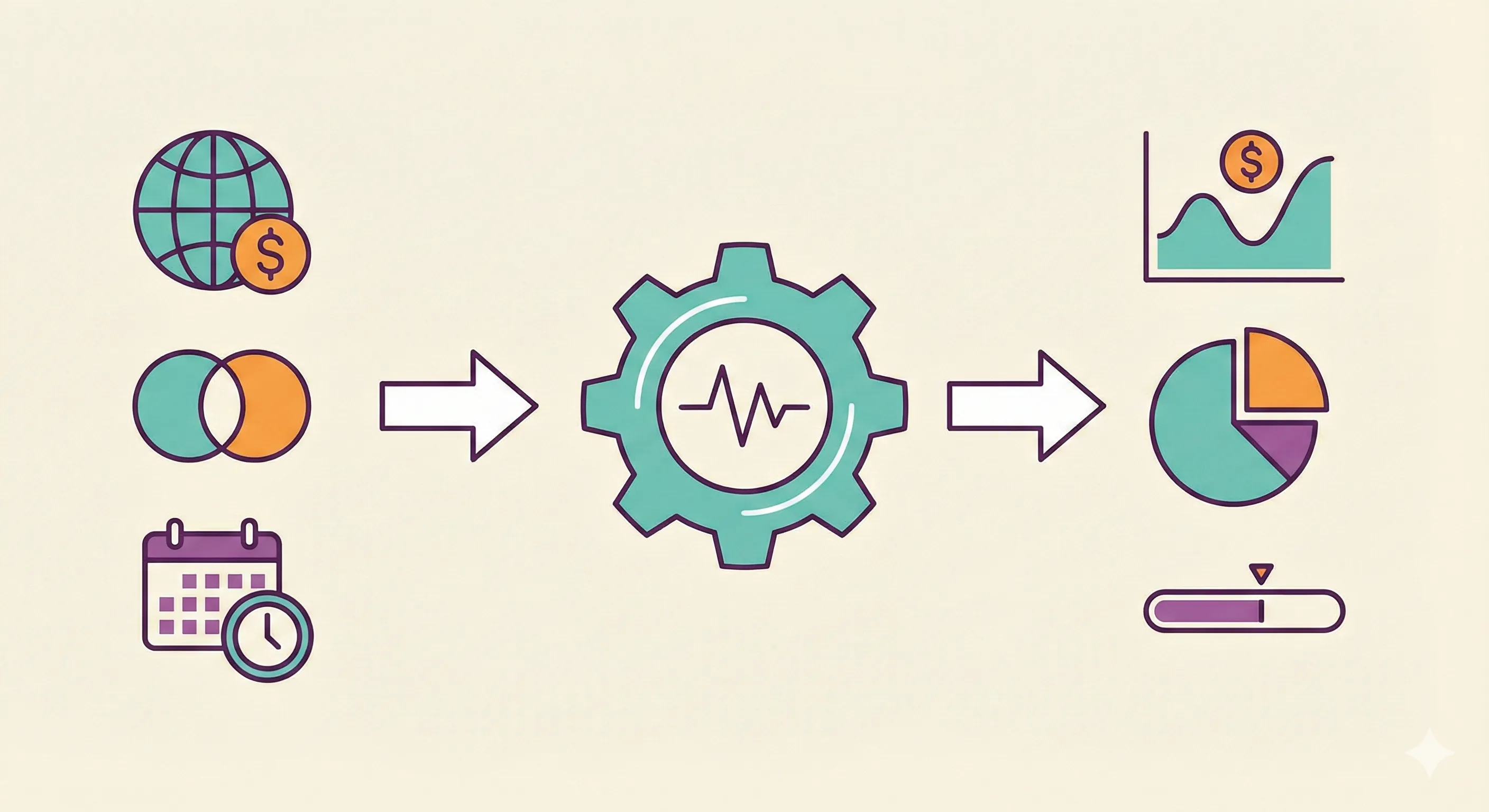
At its core, the FX Impact Estimator models the variance cost of currency movements on a selected flow of funds. Users begin by setting a base currency (e.g., USD) and defining a typical flow size, such as $500,000 per period.
The tool then applies estimated volatility by currency class - majors, crosses, and emerging markets - factoring in how much of the flow is allocated to each pair. Variance is converted into basis points, which are then translated into a dollar impact figure. This gives users a single number that captures the scale of potential FX noise. The dollar impact reflects statistical volatility exposure, not an expected loss or gain in any specific period.
Key Takeaways
- The FX Impact Estimator shows how currency fluctuations can translate into dollar costs for cross-border flows.
- Users input flow size, currency pairs, and weights to see potential variance and estimated impact.
- The tool helps highlight exposures worth monitoring, not predict future exchange rate outcomes.
Breaking Down the Inputs
- Base currency: The reference point, often the reporting or home currency.
- Valuation method: Options like daily or monthly averages change how variance is smoothed. Monthly averages, for example, reduce day-to-day noise.
- Typical flow size: The notional amount being measured, such as $500,000 in a booking period.
- Pairs used and weights: Users enter which FX pairs matter (e.g., EUR/USD, USD/BRL, USD/JPY) and what share each represents. The tool normalizes weights to 100%.
Each element helps tailor the estimate to real-world exposures. For example, a US investor making recurring payments in euros can test how shifting the EUR/USD allocation changes estimated cost.
Track investments, cash, crypto, real estate, and liabilities in one dashboard for free.
Understanding the Output
The right-hand panel displays three main results:
- Estimated variance (bps): A measure of expected volatility based on pair classes.
- Dollar impact: The notional flow multiplied by variance, shown in actual currency terms.
- Variance band: Labeled as low, medium, or high, to give context around risk level.
A pair breakdown table further shows how much each currency pair contributes to the total cost. Emerging market pairs often show higher adjusted basis points, reflecting greater volatility.
Why It Matters
Many investors assume that exchange rate risk is only relevant for global corporations. In practice, any cross-border portfolio activity can be affected - from buying an emerging-market ETF to funding overseas property.
This tool is for educational purposes only. It provides a simplified illustration of how historical currency volatility may affect multi-currency flows. The output is not a prediction, projection, guarantee, or estimate of future exchange-rate movements or portfolio outcomes. Results are based on assumptions and may differ materially from actual results. This is not investment advice, trading advice, or a recommendation regarding any currency or transaction.
How optimized is your portfolio?
PortfolioPilot is used by over 50,000 individuals in the US & Canada to analyze their portfolios of over $40 billion1. Discover your portfolio score now:

The only Net Worth Tracker you need
Track all your assets in one place for free - no hidden costs and no credit card needed.


.webp)
