
Common Mistake #37: Not Coordinating Tax-Loss Harvesting With Future Capital Gains

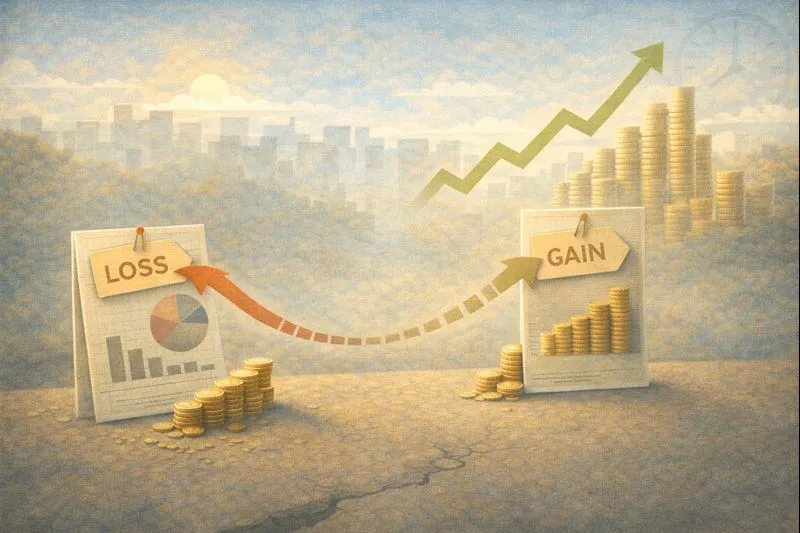
Tax-loss harvesting is often treated as a reactive move, something done in response to market declines or unexpected gains. But under US tax rules, capital losses don't have to offset gains in the same year. They can be carried forward indefinitely, waiting for future use.
Despite this flexibility, many investors harvest losses without any view of what's ahead. This article explains why failing to coordinate tax-loss harvesting with future capital gains is a common planning mistake, how it limits long-term tax efficiency, and why the biggest benefits often appear years after the losses are realized.
Key takeaways
- Capital losses can offset future gains, not just current ones.
- Tax-loss harvesting works best when viewed across multiple years.
- Large future gains often create the highest-value use cases for losses.
- Reactive harvesting can leave tax savings on the table.
- Coordination matters more than timing precision.
Why tax-loss harvesting is treated as a one-year decision
Most tax decisions are framed annually. Gains are reviewed. Losses are harvested. Forms are filed. The year closes.
That framing encourages investors to think of tax-loss harvesting as something that "solves" this year's tax bill. If there are no current gains, harvesting can feel unnecessary or premature.
Up to this point, that logic feels reasonable.
That's why many investors stop at short-term offsets and miss the longer arc.
Here's the planning dimension that often gets missed
Capital losses don't expire. Capital gains don't arrive on schedule.
Major gains often come from future events:
- Selling a long-held stock position
- Rebalancing a concentrated portfolio
- Exiting a business interest
- Selling real estate or other appreciated assets
So what? Losses harvested today can be far more valuable tomorrow, when gains are larger, and tax bills are harder to avoid.
This is where tax-loss harvesting stops being tactical and starts becoming strategic.
This is where short-term thinking limits long-term savings
Hypothetical example: Imagine an investor who experiences losses during a volatile year but chooses not to harvest them because there are no current gains. Years later, a large, concentrated stock position is sold at a significant gain.
The tax bill is substantial. Meanwhile, unrealized losses from years earlier, if harvested, could have offset a meaningful portion of that gain.
The opportunity wasn't missed because of markets. It was missed because of the planning horizon.
This is how reactive tax strategies quietly fall short.
Why future gains are hard to plan around
Future gains feel uncertain. Investors don't always know when assets will be sold or how large gains will be. That uncertainty encourages procrastination.
There's also a psychological bias at work. Harvesting losses without an immediate payoff feels incomplete. The benefit is delayed, abstract, and invisible.
But tax planning often rewards foresight over immediacy.
Losses don't need a target today to be useful tomorrow.
Why does this mistake persist even among investors
Many investors compartmentalize taxes by year because that's how reporting works. Advisors and software often reinforce this framing by focusing on current-year outcomes.
Behavioral research shows that people discount future benefits, especially when those benefits don't feel guaranteed.
The result is a tax strategy that's technically correct, but strategically shallow.
The reframe that unlocks long-term value
Investors who avoid this mistake often adopt a broader view:
Tax-loss harvesting is a multi-year inventory decision, not a single-year tactic.
This reframing shifts focus from "what does this save now?" to "what flexibility does this create later?"
Supporting considerations-such as tracking accumulated losses or understanding how they apply to different types of gains - exist to inform coordination, not to predict exact outcomes.
The goal isn't forecasting. It's optionality.
When coordination matters most
Coordinating losses with future gains becomes especially relevant for investors who expect:
- Concentrated positions to be reduced over time
- Liquidity events or asset sales
- Portfolio rebalancing after long holding periods
In these cases, harvested losses can act as a buffer, reducing friction when changes are eventually made.
Tax planning works best when it anticipates change rather than reacts to it.
How optimized is your portfolio?
PortfolioPilot is used by over 50,000 individuals in the US & Canada to analyze their portfolios of over $40 billion1. Discover your portfolio score now:

PortfolioPilot users saved $93M on taxes in 2025 (as of November 14, 2025)
It’s simpler than you think. In just 5 minutes, you can find out if there are any tax-loss harvesting opportunities available in your portfolio.11