
Using PortfolioPilot's AI Stock Screener: What It Does and How to Use It

Recent surveys indicate that over 54% of retail investors utilize stock screeners as their primary tool for decision-making. Traditional screeners often apply rigid filters - like market cap or dividend yield - without considering the broader economic environment.
The concern many investors face is whether filtering alone is enough to make well-informed choices. PortfolioPilot’s AI stock screener approaches the problem differently. It integrates macroeconomic factors, company fundamentals, and proprietary signals, then generates estimated return projections for each asset. This article explains how the system works, how data is processed, and how investors can use the tool to complement, not replace, their own judgment.
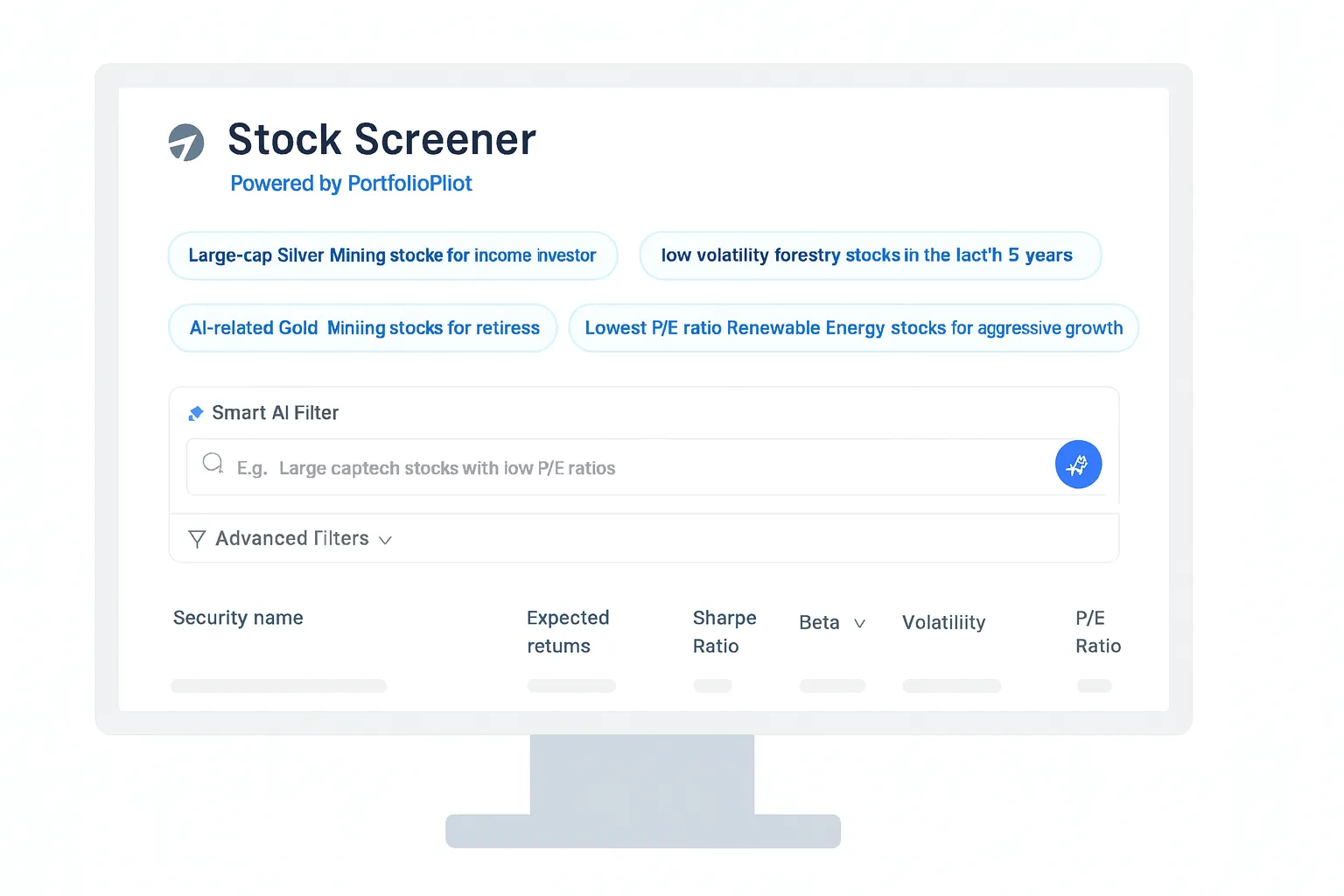
The stock screener allows investors to filter thousands of stocks by sector, market cap, region, or dividend status. It also accepts natural language input, so instead of navigating multiple drop-down menus, an investor can type queries such as “US dividend stocks with low volatility” or “technology companies with high revenue growth but low debt”.
Key Takeaways
- PortfolioPilot’s AI stock screener incorporates fundamentals, macro drivers, and proprietary data in its models.
- Assets are presented with estimated return projections, based on assumptions and simulations.
- The screener complements personal analysis, offering a structured way to compare opportunities.
- Results are model-based—not guarantees of future performance.
How the AI Stock Screener Works
PortfolioPilot’s system does more than check a company’s price-to-earnings ratio or dividend history. It combines three analytical layers:
- Macroeconomic inputs such as interest rates, inflation measures, and policy trends.
- Company-level fundamentals like revenue growth, debt ratios, and profitability.
- Proprietary indicators built from historical relationships between market behavior and asset performance.
A key difference from traditional screeners is the ability to use natural language to frame searches. This lets investors start with a plain-English idea, for example, “healthcare stocks that tend to hold up in recessions”, and see how the system translates that request into financial metrics. While the tool organizes the data, investors remain responsible for reviewing results and determining whether they align with their own strategy.
This produces a quantitative estimate of expected returns. For example, if an asset historically responds strongly to rate cycles, the model factors in current Federal Reserve policy.
Data Processing and Projections
The projections displayed in the screener are scenario-based outputs of PortfolioPilot's AI models.
- They use large datasets of historical performance and correlations.
- Assumptions are transparent, showing investors what conditions drive estimates.
- Results are presented numerically, making side-by-side comparisons possible. Projected outputs are intended to support comparison across assets, not to signal timing or conviction.
Hypothetical: Two technology companies may appear equally attractive on earnings. The screener, however, might highlight higher risk for one based on its debt structure in a rising-rate environment - helping investors weigh trade-offs more clearly.
Get recommendations across fees, taxes, risk, returns, and downside factors.
How Investors Can Use It
Natural language input can also help investors test different angles without re-building filters from scratch. A user could first ask for “large cap technology companies with strong dividends” and then adjust to “mid cap companies with low volatility in the same sector.” These iterations make comparisons faster, but the ultimate judgment about risk and suitability rests with the investor. The stock screener is not a substitute for personal judgment. Instead, it acts as a decision-support system.
- Comparison: Investors can evaluate projected outcomes across multiple assets.
- Risk context: Estimated volatility and downside scenarios are included.
- Portfolio fit: Results can be viewed in the context of an investor’s existing allocation within PortfolioPilot.
The benefit comes from efficiency - cutting down the manual work of sorting through hundreds of tickers while offering consistent, model-driven signals.
Why This Matters
A screener that integrates broader drivers helps counteract these biases. By framing opportunities quantitatively, PortfolioPilot can support more consistent decision-making.
A model-based projection can reduce overconfidence, but it also requires humility. Investors who treat projections as inputs rather than certainties are more likely to use the tool effectively. The lesson: stock screeners are most powerful when combined with discipline and long-term perspective.
¹ Return estimates are hypothetical, assumption-based, and for illustrative purposes only; they are not guarantees of future performance.
PortfolioPilot AI Stock Screener — FAQs
What percentage of retail investors rely on stock screeners as their primary tool?
How does PortfolioPilot’s AI screener differ from traditional filter-based tools?
What macroeconomic factors are considered in PortfolioPilot’s stock screener?
How does the screener incorporate company-level fundamentals?
What role do proprietary indicators play in the screener’s analysis?
How are projections presented to investors using PortfolioPilot’s screener?
Can the screener highlight risks tied to rising interest rates?
How does the AI screener help investors compare similar stocks?
What types of risk context are included in the screener’s results?
How does PortfolioPilot integrate screener results with portfolio context?
How do model-based projections reduce common behavioral biases?
Why are the screener’s outputs described as inputs, not certainties?
How does the screener improve efficiency for investors managing many tickers?
What limitations do traditional stock screeners face compared with AI-driven ones?
How might PortfolioPilot’s screener help investors in volatile markets?
What is the main advantage of combining AI projections with personal judgment?
How optimized is your portfolio?
PortfolioPilot is used by over 50,000 individuals in the US & Canada to analyze their portfolios of over $40 billion1. Discover your portfolio score now: