
Common Mistake #33: Failing to Rebalance a 401(k) or IRA

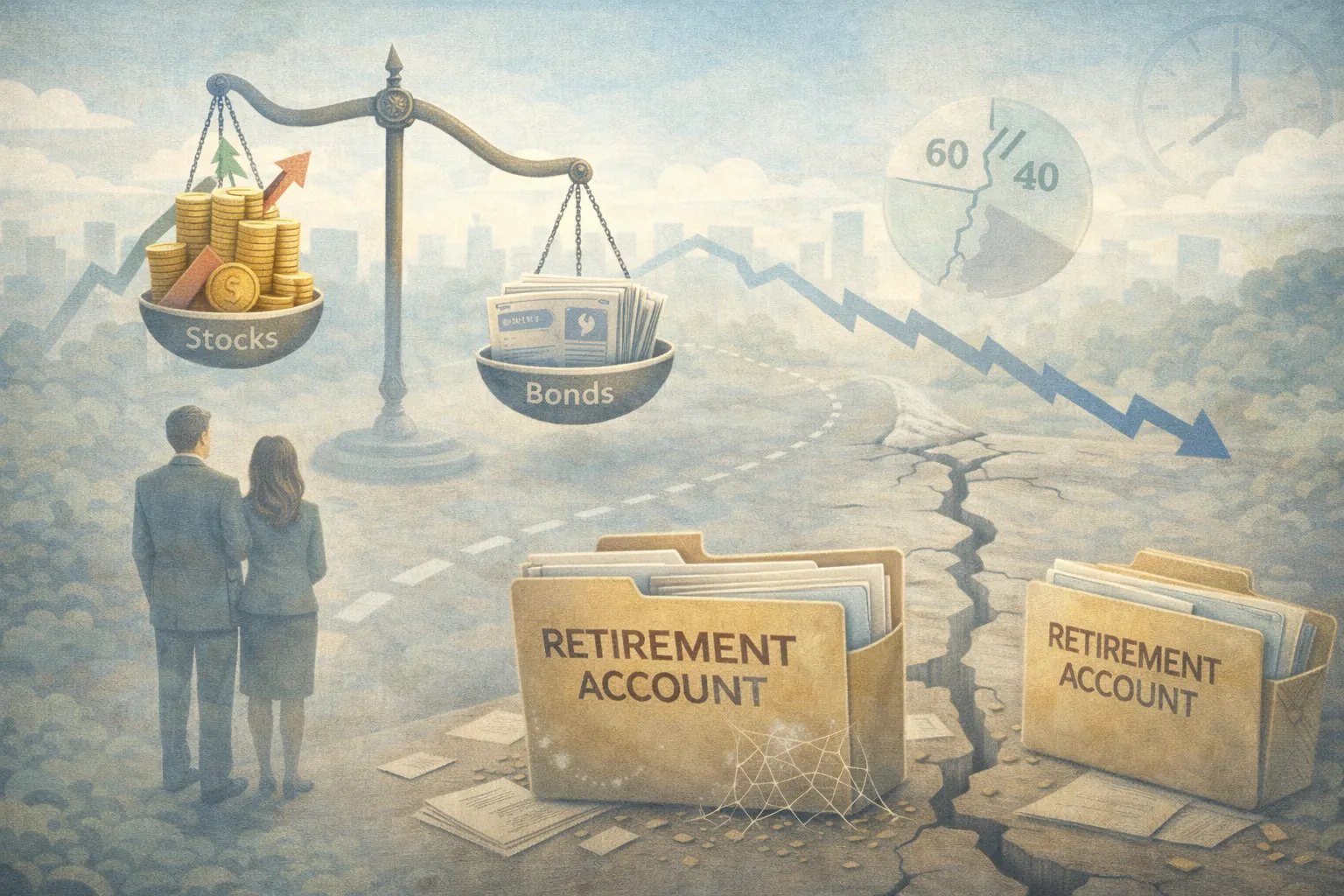
Retirement accounts are often set up once and then left alone. Allocations are chosen, contributions are automated, and attention shifts elsewhere. Over time, markets move - but portfolios don't always move with intention. According to industry guidance and long-standing portfolio management practice emphasized by firms such as Vanguard, asset allocation drift - the gradual deviation of a portfolio's actual mix from its original strategic target due to market movements - is a common source of unintended risk in long-term retirement accounts. Without regular monitoring and rebalancing, a portfolio can accumulate exposures that differ meaningfully from the investor's intended risk profile, potentially undermining long-term objectives.
This article explains why failing to rebalance a 401(k) or IRA is a common investor mistake, how it quietly alters risk exposure, and why the consequences usually appear only after volatility forces attention back to the account.
Key takeaways
- Market movements naturally push portfolios out of alignment over time.
- Drift increases risk without an explicit decision being made.
- Rebalancing is about risk control, not return maximization.
- Retirement accounts often drift unnoticed for years.
- Small allocation changes can have large long-term effects.
Why does letting a portfolio drift feel harmless
Once a retirement account is set up, one feels responsible. Contributions continue. Balances grow. Nothing appears broken.
There's also a mental shortcut at play. If markets are rising, drift feels like success. Winning assets grow larger. Losers fade into the background.
Up to this point, not rebalancing doesn't feel like a mistake. It feels like letting winners run.
That's exactly why this mistake persists.
Here's what drift changes quietly
Rebalancing isn't about fine-tuning performance. It's about maintaining the risk profile you originally chose.
When portfolios aren't rebalanced, allocations shift toward assets that have recently performed well. Over time, this can result in:
- Higher equity exposure than intended
- Greater sensitivity to market downturns
- Increased concentration in a narrow set of assets
So what? The portfolio you end up with may no longer resemble the one you agreed to hold.
| Factor | Rebalanced Portfolio | Drifted Portfolio |
|---|---|---|
| Initial allocation | Same | Same |
| Market returns | Same | Same |
| Investor action | Periodic reset | No action |
| Risk level | Controlled | Increased |
| Surprise in the downturn | Lower | Higher |
This is where risk changes without consent.
This is where drift becomes a structural risk
Hypothetical example: Imagine an investor who sets a 60/40 stock-bond allocation in a retirement account. After several strong equity years, stocks grow to 75% of the portfolio. Bonds shrink in relative importance.
The investor didn't choose more risk. Markets chose it for them.
When a downturn arrives, losses are larger than expected. The portfolio behaves differently than planned - not because of poor investments, but because of silent drift.
This is how inattention turns into surprise.
Why retirement accounts are especially vulnerable
401(k)s and IRAs are designed for long-term holding. That's a strength - but it also creates blind spots. Because these accounts are tax-advantaged:
- There's no immediate tax signal when allocations drift
- Trading friction feels unnecessary
- Statements emphasize balances, not risk composition
Over time, years can pass without a meaningful review.
The issue isn't negligence. Its design.
Why rebalancing is often postponed
Rebalancing requires action during uncertainty. It often means trimming assets that feel strong and adding to those that feel weak.
That discomfort leads to delay. Investors wait for a "better moment," which rarely arrives.
Behavioral research in finance and psychology shows that investors are prone to cognitive biases such as confirmation bias - the tendency to seek out information that supports their prior beliefs - and status-quo bias, which makes sticking with recent winners feel more comfortable than making corrective moves. These biases can make rebalancing - an intentional discipline that often involves selling recent winners or buying underperformers - feel counterintuitive, even though it enforces a structured approach to portfolio risk management.
That's why it's easy to postpone indefinitely.
The reframe that clarifies the purpose
Investors who rebalance consistently often adopt a simple reframe:
Rebalancing restores intention; it doesn't predict markets.
This framing removes the emotional charge. Rebalancing isn't a bet. It's a reset.
Supporting practices - such as annual reviews or threshold-based rebalancing - exist to maintain structure, not to chase performance.
The goal isn't precision. It's alignment.
When Rebalancing Frequency May Vary
Not every investor rebalances on the same schedule. Some use annual check-ins. Others rebalance only when allocations drift beyond set ranges.
The distinction, consistent with the rest of this series, is awareness.
Failing to rebalance becomes a mistake when drift goes unnoticed and unmanaged - not when rebalancing is handled intentionally and thoughtfully.
Risk should change by choice, not by accident.
Portfolio Drift and Rebalancing Discipline — FAQs
Why do portfolios drift over time? ▼
Is rebalancing about improving returns? ▼
Why is rebalancing easier in retirement accounts? ▼
How often do investors usually rebalance? ▼
When does failing to rebalance matter most? ▼
Why does drift often feel like success during bull markets? ▼
How does asset concentration emerge from not rebalancing? ▼
Why do investors tend to delay rebalancing decisions? ▼
Why doesn’t portfolio drift trigger obvious warning signs? ▼
How can small allocation changes have large long-term effects? ▼
How optimized is your portfolio?
PortfolioPilot is used by over 50,000 individuals in the US & Canada to analyze their portfolios of over $40 billion1. Discover your portfolio score now:

An easy way to plan your financial future
PortfolioPilot helps you plan and achieve your retirement goals, with financial models that predict your retirement success and calculate the taxes involved.